Underwater Hull Cleaning Services in Indonesia
Underwater hull cleaning services in Indonesia are a core part of ASA Marine Services, supporting vessel owners, managers, operators, and agents across Indonesian ports and anchorages. We provide underwater hull cleaning services in Indonesia using experienced diver teams, hydraulic Brushkart cleaning equipment, and photo-video documentation to help vessels address hull fouling while minimizing operational disruption and avoiding unnecessary dry-docking.
How Underwater Hull Cleaning Improves Vessel Performance
Underwater hull cleaning is an important part of maintaining vessel efficiency between dry-docking intervals. As vessels operate in seawater, marine growth gradually develops on submerged surfaces. What often begins as a thin layer of slime can develop into algae, barnacles, shell growth, tube worms, and other fouling organisms if left untreated.
For vessels operating in tropical waters such as Indonesia, fouling can develop relatively quickly due to warm water temperatures, high biological activity, and extended anchorage periods. The rate of growth varies depending on vessel trading patterns, idle time, operating area, and environmental conditions.
As marine growth accumulates, the hull surface becomes rougher and less hydrodynamically efficient. Water flowing along the hull encounters greater frictional resistance, commonly referred to as hydrodynamic drag. This additional resistance can affect how efficiently a vessel moves through the water.
For vessel owners, managers, charterers, and operators, hull fouling is more than a maintenance issue. Increased resistance can contribute to higher fuel consumption, reduced speed performance, additional engine loading, and increased operating costs over time.
The impact depends on vessel type, operating profile, speed, trading route, fouling severity, and propulsion condition. Even relatively light fouling may affect performance, while heavier fouling can significantly increase resistance and operational inefficiencies.
Regular underwater hull cleaning helps maintain a cleaner hull condition, reducing the accumulation of marine growth before it develops into heavier fouling that may require more extensive cleaning efforts. For many operators, underwater cleaning forms part of a broader strategy to support vessel performance, operational readiness, and maintenance planning between scheduled dry-docking periods.
By combining experienced diver teams, controlled cleaning methods, and underwater documentation, underwater hull cleaning allows vessel operators to assess and address fouling conditions while minimizing disruption to vessel schedules.
How Marine Growth Affects Vessel Performance
Industry Observation
Various maritime studies and industry observations have reported that hull fouling may contribute to measurable increases in vessel resistance and fuel consumption.
When a vessel moves through water, a layer of water continuously flows along the hull surface. Naval architects and hydrodynamic specialists pay close attention to the interaction between this water flow and the hull because it directly influences vessel resistance and propulsion efficiency.
A clean hull provides a relatively smooth surface for water flow. However, as slime, algae, shell growth, tube worms, barnacles, and other marine organisms accumulate, the hull surface becomes increasingly rough. This roughness disrupts the natural flow of water and increases frictional resistance along the vessel’s underwater body.
This increase in resistance is commonly referred to as hydrodynamic drag. In simple terms, the vessel experiences greater friction as it moves through the water. The rougher the hull surface becomes, the more energy is required to overcome this resistance and maintain vessel speed.
As hydrodynamic drag increases, the vessel may require additional engine power to maintain the same operating speed. Depending on vessel condition and operating profile, operators may observe:
– Increased fuel consumption
– Reduced vessel speed
– Higher engine loading
– Reduced propulsion efficiency
– Increased emissions associated with additional fuel use
– Higher operating costs over time
The effect is often progressive rather than immediate. Small amounts of slime may initially have limited operational impact, while heavier fouling and barnacle growth can significantly increase resistance and reduce vessel performance.
For this reason, many vessel operators monitor hull condition closely and schedule underwater inspections or cleaning before fouling develops into a more severe condition. Understanding the level of fouling present is often the first step in determining the most appropriate cleaning approach.
Common Types of Hull Fouling Found in Indonesian Waters
Indonesia’s warm tropical waters, high biological activity, and busy anchorage areas can create favourable conditions for marine growth on submerged vessel surfaces. The type and severity of fouling can vary depending on trading patterns, idle periods, water temperature, vessel speed, and maintenance practices.
Understanding the different forms of fouling can help vessel operators assess hull condition and determine when underwater inspection or cleaning may be appropriate.
Slime Formation
Slime is often the earliest stage of hull fouling. It appears as a thin biological film consisting of microorganisms, bacteria, and organic material that gradually accumulate on submerged surfaces.
Although slime may appear relatively minor compared to heavier fouling, it can already increase hull surface roughness and affect water flow around the vessel. If left untreated, slime can create a foundation for more advanced marine growth.
Tube Worms
Tube worms attach themselves to underwater surfaces and create hard protective structures that can remain firmly bonded to hull coatings.
As tube worm growth increases, cleaning requirements may become more extensive. Their presence is often associated with longer immersion periods and warm-water operating environments.
Algae Growth
Algae commonly develop on vessel hulls operating in warm coastal and tropical waters. Depending on environmental conditions, algae may form patches or larger areas of soft marine growth across the underwater hull.
As algae accumulates, the hull surface becomes less smooth, increasing resistance between the vessel and the surrounding water. Regular inspection can help identify algae growth before it develops into heavier fouling conditions.
Shell Growth and Marine Encrustation
Shell growth refers to larger marine organisms and hard fouling that accumulate over time. Depending on the vessel’s operating profile, shell growth may appear on flat bottoms, vertical sides, sea chest gratings, rudders, and other submerged structures.
This type of fouling generally requires more effort to remove than slime or algae and may have a greater impact on vessel performance if allowed to develop unchecked.
Barnacles
Barnacles are among the most recognisable forms of marine fouling. These hard-shelled organisms attach firmly to submerged surfaces and can significantly increase hull roughness.
Heavy barnacle growth may affect vessel performance by increasing hydrodynamic resistance and making the hull more difficult to clean if left untreated for extended periods. Barnacles are commonly found on vessels that spend significant time at anchor or operate in biologically active waters.
Mixed Fouling Conditions
In practice, vessel hulls often exhibit a combination of several fouling types rather than a single form of marine growth.
A hull may contain slime, algae, barnacles, tube worms, and shell growth simultaneously, with varying levels of severity across different areas of the vessel. This is why underwater inspection is often an important first step in evaluating hull condition and determining the most appropriate cleaning approach.
Because fouling conditions vary between vessels, locations, and operating profiles, underwater inspection is often used to assess the extent of marine growth before cleaning begins. Once the hull condition is understood, the cleaning method, equipment, and work scope can be planned accordingly to support safe and efficient execution.
Hull Cleaning Challenges in Indonesian Waters
Indonesia is one of the world’s largest maritime nations, with thousands of islands, extensive shipping routes, busy anchorages, and year-round tropical conditions. While these waters support international trade and domestic shipping activity, they also create environmental conditions that can accelerate marine growth on vessel hulls.
For vessel operators, underwater cleaning projects in Indonesia often require consideration of local operating conditions, anchorage environments, weather patterns, vessel schedules, and location-specific requirements.
Tropical Water Temperatures
Indonesia’s tropical climate allows marine organisms to remain active throughout the year.
Unlike colder regions where biological growth may slow significantly during winter periods, vessels operating in Indonesian waters can experience continuous fouling development throughout all seasons.
As a result, slime, algae, barnacles, tube worms, and shell growth may accumulate relatively quickly depending on vessel activity and idle periods
Extended Anchorage Periods
Many commercial vessels spend time waiting at Indonesian anchorages while awaiting cargo operations, berth availability, inspections, bunkering, or other operational requirements.
During these waiting periods, vessel movement is reduced, allowing marine growth to attach and develop more easily on underwater surfaces.
The longer a vessel remains stationary, the greater the opportunity for fouling to accumulate.
Weather and Visibility Conditions
Underwater inspection and cleaning activities are often influenced by weather, sea state, current strength, and underwater visibility.
Depending on location and season, visibility may range from relatively clear conditions to heavily restricted visibility environments.
Work planning frequently considers these conditions to support safe and effective execution.
Variation Between Locations
Fouling conditions can vary significantly between different Indonesian regions.
Because operating conditions differ from one port and anchorage to another, underwater cleaning projects often require a flexible and location-specific approach. Understanding local conditions helps support safe execution, realistic planning, and effective cleaning outcomes throughout Indonesia.
Factors that may influence fouling development include:
• Water temperature
• Salinity
• Biological activity
• Tidal movement
• Seasonal conditions
• Anchorage duration
A vessel operating between several Indonesian ports may experience different fouling patterns throughout its trading cycle.
Operational Schedule Pressure
Many vessel operators seek underwater cleaning while minimizing disruption to vessel schedules.
This often requires careful coordination between:
• Vessel operators
• Technical managers
• Port agents
• Masters
• Local authorities
• Service providers
Efficient planning can help reduce operational delays while ensuring cleaning activities are completed within available time windows.
Because operating conditions differ from one port and anchorage to another, underwater cleaning projects often require a flexible and location-specific approach. Understanding local conditions helps support safe execution, realistic planning, and effective cleaning outcomes throughout Indonesia.
Equipment & Technology
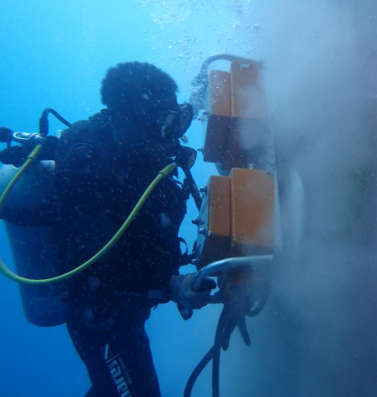
ASA Marine Services combines hydraulic cleaning equipment, underwater documentation systems, and experienced diver teams to support underwater hull cleaning, propeller polishing, inspection, and commercial diving operations.
Our Underwater Hull Cleaning Process
Initial Inspection
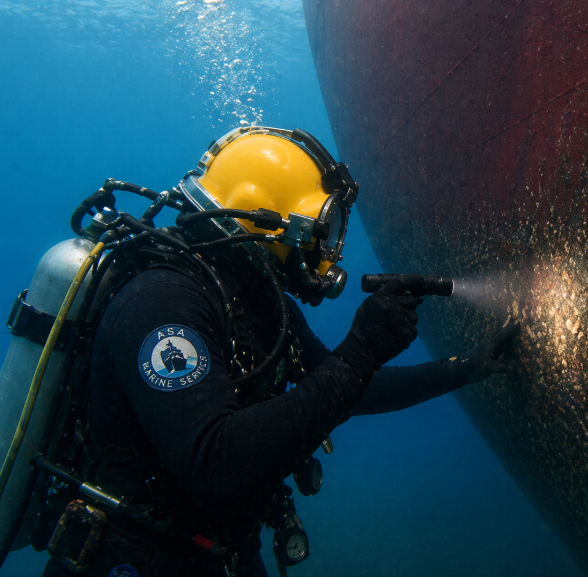
Before cleaning begins, our diver team performs a visual assessment of the underwater hull condition. This helps identify the type and severity of fouling present, areas requiring particular attention, and any operational considerations that may affect the cleaning process.
The inspection may include:
• Hull condition assessment
• Fouling identification
• Sea chest and intake observation
• Propeller condition review
• Documentation of visible findings
This initial assessment helps establish the appropriate cleaning approach before work proceeds.
Hull Cleaning Operation
Following assessment, divers perform underwater cleaning using suitable cleaning methods and equipment based on vessel condition and fouling severity.
ASA utilizes hydraulic Brushkart cleaning equipment and experienced diver teams to remove marine growth from underwater hull surfaces while maintaining a controlled cleaning process.
Cleaning scope may include:
• Vertical sides
• Flat bottom areas
• Bilge keel sections
• Rudder surfaces
• Sea chest grating areas
• Propeller cleaning or polishing when required
Work execution remains subject to vessel condition, weather, visibility, port requirements, and operational limitations.

Reporting & Documentation
Upon completion, ASA provides visual documentation to support operational records and review of completed work.
Depending on project requirements, deliverables may include:
• Before and after photographs
• Underwater video recordings
• Diver observations
• Preliminary work summary
• Soft-copy report
Documentation provides vessel operators with a visual reference of hull condition and cleaning activities performed during the project.
FAQ – Underwater Hull Cleaning
Coverage for Underwater Hull Cleaning Services in Indonesia
ASA Marine Services supports underwater hull cleaning operations across Indonesian ports, anchorages, offshore locations, and waiting areas where vessel operators require underwater maintenance without dry-docking.
Our team has experience coordinating underwater services in major maritime regions including Batam, Karimun, Dumai, Belawan, Jakarta, Cirebon, Semarang, Surabaya, Gresik, Balikpapan, Banjarmasin, Samarinda, Bunati, Makassar, Bitung, Sorong, and other locations throughout Indonesia.
Because each port and anchorage presents different operational conditions, we work closely with vessel representatives, agents, and local stakeholders to plan underwater cleaning activities efficiently while considering vessel schedules, weather conditions, visibility, and local requirements.
Whether supporting a vessel alongside, at anchorage, or during a scheduled maintenance window, ASA Marine Services remains ready to arrange underwater hull cleaning, propeller polishing, inspection, and diving support across Indonesia.
ASA provides underwater hull cleaning Indonesia support for commercial vessels operating across ports and anchorages.
Our underwater hull cleaning Indonesia work is planned based on fouling condition, vessel schedule, and local operating constraints.

Contact us
Contact our team to request hull cleaning support.
Name: Yuli Rosiana – Director/Business Development
Phone/WhatsApp: +62 822-8170-0294
Email: yrosiana@asamarineservices.com
WeChat: yuli-rosiana
Name: Dodi Kurniawan – Operations
Phone/WhatsApp: +62 813-1754-5251
Email: ops@asamarineservices.com
WeChat: dodikurniawan-bdasa
Name: Rizky Alamsyah – Operations
Phone/WhatsApp: +62 811-1201-2259
Email: rizky.a@asamarineservices.com
WeChat: Rizky_Alam_Syah
Related Marine Diving Services
In addition to underwater hull cleaning, ASA also provides:
> Propeller polishing services to improve propulsion efficiency
> Underwater inspection for condition checks and reporting
> In-water repair and underwater welding support
Our services can be combined to meet operational and inspection requirements without dry-docking.
Underwater welding
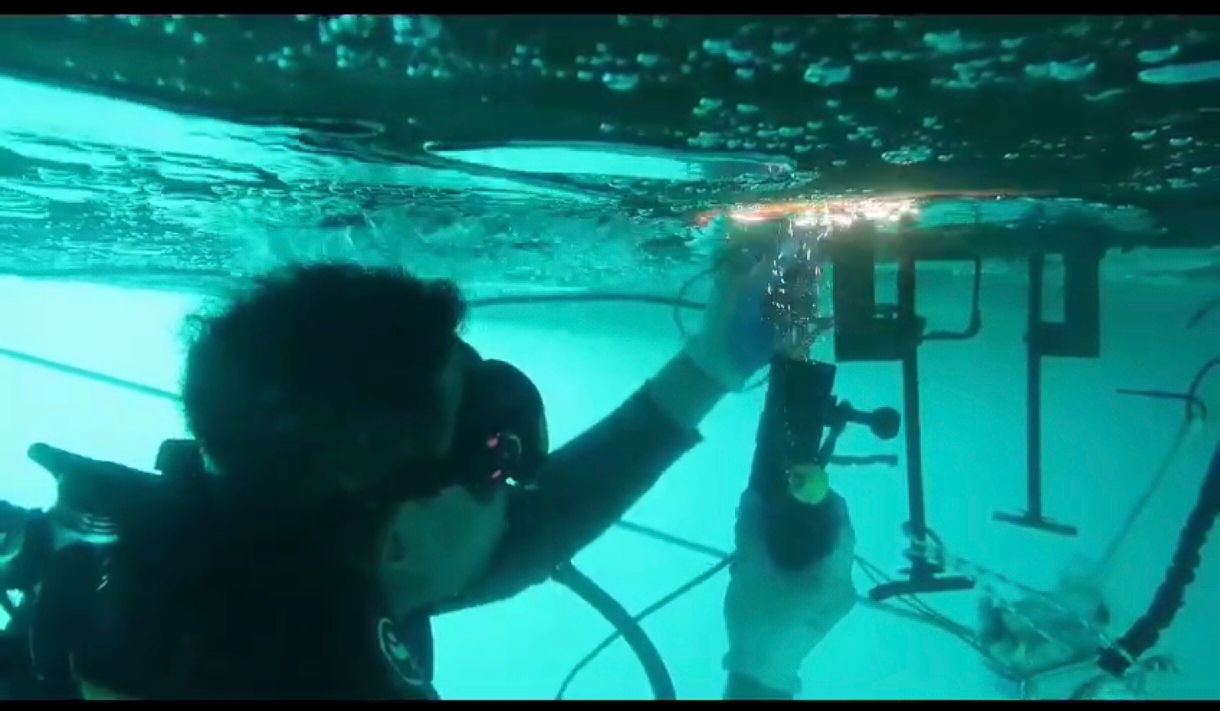
Underwater welding services provide critical repair solutions for vessels without the need for dry-docking. Our diver teams support urgent structural repairs below the waterline, helping ship operators minimize downtime, maintain operational continuity, and address damage safely and efficiently in-port or at anchorage.
Underwater repair
Provide in-water repair solutions including underwater welding and structural support to address minor damage without dry-docking. Our diver teams help vessels maintain operational continuity while ensuring safe and compliant execution.